A new year means new skills and adventures!
I am so excited to get started together this year! This is your 12th grader’s LAST year as a high school scholar, and I am looking forward to our partnership in helping them transition to adulthood during this fun and stressful time.
To see the grading policy for this class, click on the picture or click here. We will review this policy in class, and scholars will sign a copy, which I will keep in the portfolio. If you have any questions about what you see, let me know. 🙂

What to expect in English IV
English IV | Overview and Google Classroom
This year is about sharpening our reading, writing, and critical thinking skills. All these are essential real-life skills your scholars will need in their academic and professional lives.
Our focus is on European literature from the Medieval period to post-World War II. Last year, your scholars focused on American Literature, so this year, we’re going global. They will be reading various genres of fiction and nonfiction, such as epic and romantic poetry, short stories, novels, critical essays, and humorous essays. We’ll discuss history, art, music, culture, and themes on a macro- and micro-scale.
As a parent or guardian, you are able (and welcome!) to access and view our Google Classroom. Check out this short article to learn about Guardian Access to Google classrooms.
Google Classroom Codes:
Code for A Days: 7llutcx
– This is for scholars who have me on A Days (2nd, 4th, or 5th period)
Code for B Days: s67ucoa
– This is for scholars who have me on B Days (7th, 8th, or 10th period)
We will be using StudySync both online and via workbook. ALL scholars must have their Chromebooks charged and in class every day. We will be doing online activities, but a lot of what we do in class is good, old-fashioned paper and pencil.
Supplies:
Be sure your scholar comes to class prepared with the following:
1. A notebook
2. A pen or pencil
3. Their Chromebook and charger
Chromebook questions and issues should be directed to Ms. Brown at karen.brown@manorisd.

Reading
Novel Studies and Language Accommodations
This year, we will be reading a lot! If your scholar is not a prolific or fluent reader, that is OK! We work together, we read together, and we grow together.
I am happy to announce that we will be doing three (3) novel studies this year.
Unit 1: “The Metamorphosis” by Franz Kafka
Unit 5: “1984” by George Orwell
Unit 6: Scholar self-select
The novels selected meet the Texas Education Agency’s requirements for rigor and are appropriate for our grade level. More than that, these stories allow scholars to debate their understanding of their lives and how they relate to society. I can’t wait to see what brilliant thoughts they’ll share in our discussion.
For parents who are interested, I will be providing extension activities. These will include themes and questions that you can use to engage your children in discussions about their reading. This is a great opportunity to reinforce their learning and have meaningful conversations about what they’re discovering in the novels.
If you want to read along, let me know! I can help find the text for you.
It’s important to note that if your scholar is still working on their English language skills, that’s perfectly fine. We have texts available in multiple languages, and while our goal is for scholars to eventually read, write, and discuss in English, they will always have access to the course content in their language when needed.

Writing
Dun Dun DUUUUUN! Writing! Many scholars absolutely hate writing, but it is a critical and necessary skill for their lives. We will complete a writing assignment every six weeks, and at the end of the year, your scholar should have a portfolio of work.
Unit 1: College Entrance Essay
Not all of our scholars are college-bound, but each year, we work on answering the Apply Texas prompt. This helps fulfill our requirement for scholars to write informative texts, and those scholars applying to Texas colleges will have their application essays done, edited, and polished.
Unit 2: Short Constructed Responses
We will be working on short constructed responses to prompts about our readings. Scholars will also be able to create graphic novels and visualizations of the stories we are reading.
Unit 3: Extended Constructed Responses
We will work on extended constructed responses that ask scholars to share, cite, and analyze themes and ideas in our texts.
Unit 4: Poetry
Scholars will write, peer edit, and recite an original poem. While many scholars initially hesitate to do this, this exercise becomes one of their favorites.
Unit 5: Dialectical Journaling
Scholars will explore and discuss the themes of “1984” via creative writing exercises.
Unit 6: Argumentative Text
Scholarswill write an argumentative text based on a pre-selected prompt. We will work on this in class, and your scholars will receive support and help. Hopefully, by the time we begin this endeavor, your scholar will feel comfortable with the writing process and ready to tackle this challenge.
In addition to our 6 writing projects, scholars are required to take notes, annotate, and engage in writing activities as part of our daily classwork. I realize our scholars are at different levels of their writing ability: THAT IS OK! I am here to support them wherever they are on their journey.

Critical Thinking
As many experts agree, critical thinking is not just a skill, but a necessity in the 21st century. It’s a life skill your scholars will need to fully participate in their lives, and I’m here to ensure they are well-equipped.
What do I mean when I say critical thinking?
This year, your scholar will be engaged in a rigorous debate about our texts, themes, current events, and topics relevant to their everyday lives. My goal is that your scholar will leave my class with the ability to communicate their thoughts and ideas effectively and respond to others professionally and intellectually rigorously.
It is too easy for young people to be dismissed because of how they present themselves. My goal is to ensure your scholar is a force to be reckoned with, a person who can confidently express their ideas and thoughts and analyze what they are being told to help them navigate good information from wrong information.
This is really one of my favorite parts of the class. Am I excited your scholar will be reading Shakespeare and Orwell? Absolutely. But my main goal is that your scholar knows how to read an employment contract, send a professional email, and engage in their lives in a way that makes it difficult for others to dismiss them. This is about accountability and empowerment, and it is awesome to see your scholars grow in this area. I’m proud to be a part of their personal growth journey, and I’m sure you are too.

Accomodations
I strive to create a safe and equitable environment for all scholars. I have a child who receives accommodations, so I know firsthand how frustrating the process can be. Once I receive information about your child’s accommodations, I will send you a message confirming what I have.
I aim to create a documentation document you will have access to. I want to update that with information about your scholar’s progress, accommodations, challenges, and wins.
If you ever feel frustrated or unsure about what is happening, please contact me. I am committed to being a resource for my family and can usually answer emails the same day. Open communication is key to ensuring your child’s success.
About Me
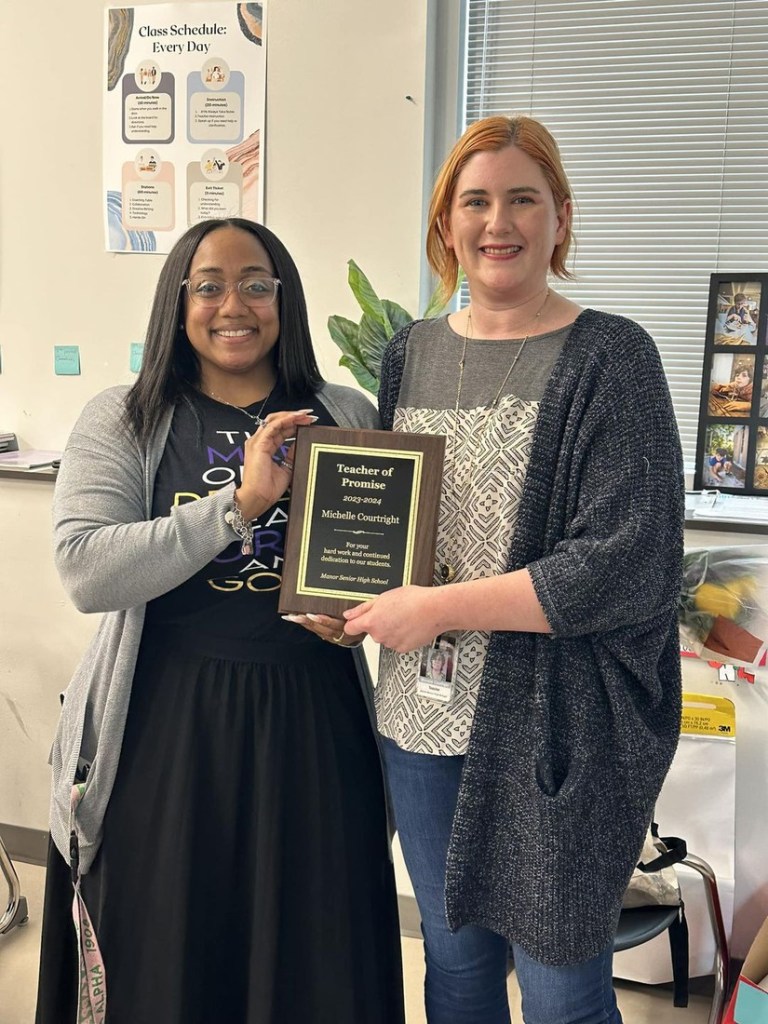
My name is Michelle Courtright, and this is my second year teaching at Manor Senior High School. I am a mother of three: a six-year-old, a ten-year-old, and a 15-year-old. I know what it’s like to have kids in school: once they leave elementary school, you stop hearing from teachers, and it can be hard to figure out what is happening day to day unless there is a problem. This is a big reason I try very hard to be communicative and give you all updates on what we’re doing in our classes.
My areas of expertise include English literature, reading, writing, rhetoric, art history, world history, digital marketing, music, and journalism. I incorporate art, history, and music into my lessons to help create a broader, more meaningful experience with our curriculum.
I’ve worked in corporate America and owned my own business, so I try to incorporate real-world skills and scenarios into our lessons. I have hired and fired, trained and mentored, and seen the skills that set successful people apart from others.
Your scholar is allowed to have a bad day in my class.
We are all human, and we all have bad days. I encourage our scholars to communicate with me if they’re just “not feeling it” or if they need some time. If your scholar has a challenging day in my class, that is okay. I have a big heart and a short memory. I will always be happy to see your scholar in my room.
Your scholar is safe in my class.
My class is safe for scholars of all races, orientations, religions, and backgrounds. We engage in healthy and respectful debate, but we do not engage in personal attacks or bullying. I have a zero-tolerance policy for hate speech, aggression, and disrespect. All of our scholars deserve to be safe and productive in class.
Your scholar will be supported in my class.
We do a lot of our classwork together. My inclusion teachers work with ALL of our scholars, and student mentorship opportunities are available for leadership. If your child needs additional support, they will get it. If your child has language or 504 accommodations, they will get it. You will hear from me to confirm I have their information. If you are still waiting to hear from me in the first three weeks of school, feel free to reach out.
Your scholar will be held accountable in my class.
We are practicing for the real world in my class. Scholars are given everything they need to do well; their grade and the quality of work rests on them. I am supportive and empathetic, but I hold all of my scholars to a high level. If they ever need help, they have to communicate that to me, BUT I can only support them if they let me know. It’s up to them to talk to me if they need something they’re not getting. This is a critical life skill: they cannot just let life happen to them; they must take an active role.
 Ms. Courtright's Class
Leave a comment